



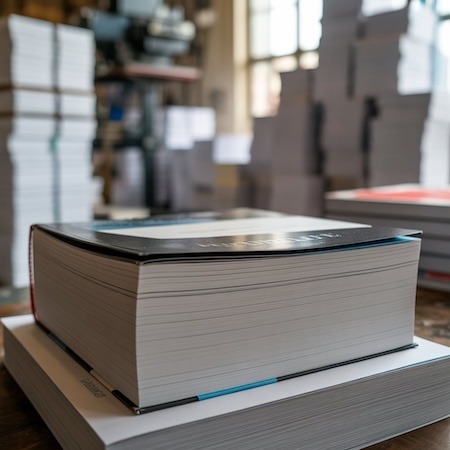

PUR binding is currently one of the most popular ways of gluing books. It is durable, opens well and allows the production of both thin publications and very thick books. In practice, however, the larger the volume, the more technological challenges arise during production.
Many people assume that PUR “solves everything.” It does indeed give much better durability than classic EVA bonding, but with very thick books you still have to be careful about several important issues.
Below we show 5 problems that most often arise with thick publications made with PUR technology.
PUR vs. too much book volume
The first problem is very simple: not every book stands up well to very high thickness. Even if the PUR binding is strong, there is a lot of stress on the spine with publications of 500-700 pages.
The heavier the block:
- the higher the bonding load
- the harder the back works when opening
- the more difficult it is to maintain the ideal shape of the book
Therefore, for very thick publications, printers often recommend sewn-and-glued binding instead of PUR alone.
PUR binding and book opening problem
PUR binding opens much better than classic glued binding, but with very thick books there can still be limitations.
The problem is especially true for:
- heavy weight papers
- stiff chalkboard papers
- books with a large number of pages
The thicker the paper, the harder it is for the book to open naturally. In practice, even a good PUR binding will not make a very thick album open completely flat.
PUR binding vs. mismatched paper
Paper has a huge impact on the durability of a book. That’s why PUR requires that the material be properly matched to the volume of the publication.
With thick books, problems often result:
- very slippery chalkboard paper
- too high grammage
- paper with high stiffness
Much better suited are more flexible papers, such as:
- Munken Print White
- Munken Cream
- Holmen Book Cream
Such materials work better when opening the book and put less stress on the spine.
PUR binding and poorly prepared spine
With thick books, the correct preparation of the cover is of great importance. Even a small error in the width of the spine can be very visible after production.
PUR binding requires careful calculation:
- number of pages
- type of paper
- grammage
- block volume
If the ridge is improperly prepared:
- graphics may shift
- text on the spine will be uneven
- the cover may not fit properly
Therefore, the printer always calculates the spine individually for a specific project.
Transport of thick books
This is a problem that customers often don’t think about. Thick books are simply heavy, and this affects logistics and durability during transportation.
With very large volumes, there can be:
- cover deformation
- pressure on the spine
- corner damage
Therefore, PUR for thick publications very often requires:
- stronger cardboard cover
- additional packaging
- smaller shipping cartons
In practice, proper safeguarding of books is as important as the production itself.
Is PUR binding suitable for thick books
Despite these challenges, PUR still remains a very good solution for thick publications. It gives high durability and much better flexibility than traditional EVA bonding.
The key, however, is proper design and matching the technology to the volume of the book.
In many cases, the best result comes from bonding:
- well-chosen paper
- correctly calculated back
- appropriate basis weight
- proper cover construction
Summary
PUR binding works well for many types of publications, but very thick books require special attention. The most common problems relate to volume, opening, paper and spine design.
That’s why, for large projects, it’s a good idea to consult the parameters with the printer at the beginning of book preparation. In practice, properly selected PUR binding can significantly improve the durability and comfort of the entire publication.