



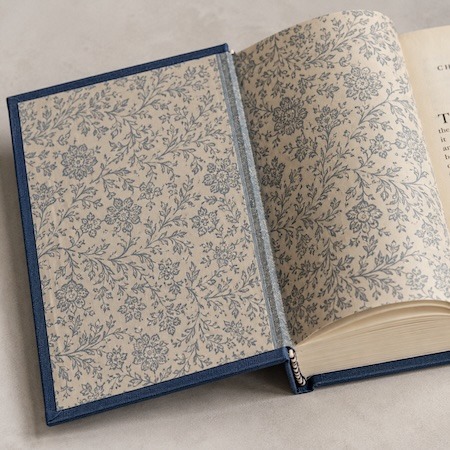

Most people pay attention to the cover, the paper inside, or the type of binding. Yet one of the elements that most strongly influences the first impression upon opening a book often goes unnoticed. It is the endpaper.
Although it takes up only a few pages at the beginning and end of the book, the endpaper serves both a technical and an aesthetic function. When well-chosen, it can highlight the character of the publication, increase its durability, and make the book look more professional.
That’s why it’s worth knowing what an endpaper actually is and why the printer asks about it when producing hardcover books.
Endpaper – what exactly is it?
An endpaper is a sheet of paper that connects the book block to the hardcover. One side is glued to the inside of the cover, while the other serves as the first or last page of the book.
Every hardcover book has an endpaper on the front and back. Without it, it would not be possible to permanently bind the book’s interior to the cover.
Although the endpaper primarily serves a structural function, today it is increasingly becoming an integral part of the graphic design.
Endpapers and the durability of a book
One of the most important functions of the endpaper is to absorb the stress generated when opening and closing a book. It helps keep the book block in the correct position and reinforces the entire binding structure.
For heavy albums, cookbooks, or thick publications, a properly selected endpaper has a huge impact on the durability of the finished product. That is why printing houses usually use paper with a higher basis weight for this purpose than that used inside the book.
The larger the book’s volume, the greater the importance of the endpaper’s quality and durability.
Endpaper as part of the design
Just a few decades ago, most books simply had plain white endpapers. Today, publishers are increasingly using them as additional design space.
Depending on the design, the endpaper can be:
- white or colored,
- made of decorative paper,
- printed with a graphic, illustration or pattern.
As a result, as soon as the cover is opened, the reader receives the first indication of the nature of the publication.
Such solutions often appear in albums, collector’s books, premium editions or children’s publications. A well-designed cover helps to build coherence of the whole project and makes the book look more polished.
Endpapers vs. Premium Book Printing
If the goal is to print a premium book, the endpaper very often becomes an important part of the whole concept.
In premium books one encounters coverstocks matching the color of the cover or printed with an author’s design. Sometimes they feature maps, illustrations, photographs or additional graphics related to the content of the publication.
This is a relatively simple way to increase the attractiveness of the book without the need for a lot of additional finishing. In many projects, the visual effect achieved by an interesting endpaper is greater than after applying another layer of UV varnish or embossing.
Choosing paper for the endpapers
Not all paper is suitable for endpapers. The material must be strong enough to support the weight of the book block for many years of use.
The most commonly used papers are heavyweight offset papers, decorative papers, or through-dyed papers. When selecting the material, not only its color but also its texture, stiffness, and behavior during gluing are taken into account.
For this reason, the endpaper often differs from the paper used inside the book. This is due not only to aesthetics but primarily to technical requirements.
Endpapers with or without printing
This is one of the questions that often comes up during the design process.
A classic unprinted endpaper is a versatile and cost-effective solution. It works perfectly for novels, academic publications, and business books.
However, printed endpapers are becoming increasingly popular. The most common elements found on them include:
- maps,
- illustrations,
- photographs,
- elements of the publisher’s visual identity.
Some authors also use this space to include additional content not found in the main body of the book.
Production cost
Many people assume that a endpaper is just a technical add-on and has little impact on the cost of production. In practice, the difference between a simple white endpaper and a endpaper printed on decorative paper can be noticeable. Especially for larger print runs.
At the same time, it is one of those elements that, at a relatively small cost, can significantly improve the perception of the entire publication. Therefore, in premium editions, endpapers often give a better effect than another cover enhancement.
Why does the printing company ask for the endpaper?
Customers often focus on the number of pages, the paper used for the interior, and the cover. However, the endpaper affects both the durability and the appearance of the finished book.
As early as the quoting stage, the printing house needs to know whether the endpaper will be white or colored, printed or unprinted, and what type of paper will be used for its production. This information allows for the correct selection of technology and the preparation of an accurate cost estimate.
Summary
The endpaper is one of the most underappreciated elements of a book. Although most readers don’t consciously notice it, it has a huge impact on the durability, aesthetics, and overall impression of the publication.
That is why it is worth treating it not only as a structural element but also as part of the graphic design. In many cases, a well-designed endpaper makes the book look much more professional, cohesive, and attractive from the very first time it is opened.