



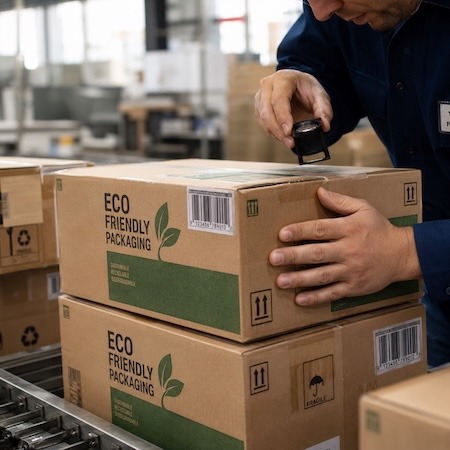

Box printing is not one price per piece, but the sum of several factors: material, print run, number of colors, format and finishing. Two seemingly identical boxes can differ in cost by up to several times – just change one of these elements.
This question is the first thing customers ask before they even send a design. And rightly so – without knowing these variables, it’s difficult to even begin a conversation about a specific offer.
Why the price of box printing is not a single number
Unlike many products, cardboard packaging does not have a single, fixed price per item regardless of the order. The cost is formed from several independent components that multiply by each other rather than add up. Therefore, a small change in one component can shift the final price significantly.
The printer asks for design details not to complicate pricing, but because each factor changes a different stage of production – from die preparation to machine time.
Volume vs. price of box printing
The size of the print run has the greatest impact on the unit price. With small volumes, the cost of production preparation – dies, die-cutting molds, machine setup – is spread over few units, so the price per box is high. With large runs, the same cost of preparation is spread over thousands of copies, so the unit price drops sharply.
| Quantity | Impact on unit price |
|---|---|
| up to 500 pieces | high, preparation costs dominate |
| 500-5000 pieces | a marked drop in price per unit |
| over 5000 pieces | Price stabilizes, material cost dominates |
Box printing vs. type of material
Solid cardboard, corrugated cardboard or microwave differ not only in the price of the raw material itself. Also in the way they are processed. Solid cardboard will give a more precise print, but it won’t protect the product as well as corrugated cardboard. And this affects whether you need to add additional protection to your project in transit.
The thickness of the material also matters. Thicker cardboard not only means a higher raw material cost, but also slower operation of the die-cutting machine, which translates into production time and cost.
Format and design vs. price of cardboard packaging
A standard box format – for example, a simple crease-folded design – is less expensive than an unusual shape requiring a custom die-cutting mold. A new mold is a one-time cost that, for small runs, can exceed the cost of printing alone.
The more complex the design – inserts, partitions, locks without glue – the more time it takes to design and prepare production, and this translates directly into price.
Number of colors vs. box printing
Printing in full color (CMYK) costs differently than printing in one or two spot colors. With large print runs, the difference is sometimes small, because the machine prints all colors at once anyway. With small print runs, an additional spot color, requiring separate ink preparation, can noticeably raise the price.
It is also worth remembering that the color directly under the cutting edge or in the folding areas requires greater precision – and this increases the risk of production waste, which is included in the price of the entire order anyway.
Enhancements vs. price of box printing
UV varnish, matte or glossy foil, embossing or window cutting – each of these refinements is a separate production step, a separate machine and separate downtime between processes. The more refinements on a single package, the longer the production path and the higher the final cost.
Interestingly, a single, well-chosen enhancement – for example, just a selective UV varnish on a logo – is often more impressive than several enhancements at once, and costs noticeably less.
Box printing vs. cost of shipping and storage
The price of the printing itself is not the end of the cost, which is worth thinking about before ordering. Folded boxes take up more space in transit than those delivered flat, to be assembled by the customer himself. For large print runs, the difference in logistics costs can be noticeable, especially for international shipments.
It’s worth discussing this with the printer already at the quotation stage – sometimes a small change in the way boxes are delivered reduces the total cost of the order more than negotiating the price of printing alone.
Summary
The price of box printing depends on several independent factors: print run, material, format, number of colors and finishing. The biggest influence on the unit price is the size of the order – the larger the print run, the more strongly the cost of production preparation is distributed. Before pricing, it’s useful to be clear about these variables, because they, and not the “price per unit” itself, determine the final cost of packaging.
FAQ
On what does the price of box printing depend most?
The biggest influence is the size of the input – with small volumes, the cost of production preparation dominates, with large volumes, the cost of material is mainly determined.
Does the unusual shape of the box significantly increase the price?
Yes, especially for small print runs, because it requires an individual die-cutting mold, the cost of which is spread over a smaller number of pieces.
Do more colors always mean a higher price?
With large print runs, the difference is small, because the machine prints all colors at once. With small print runs, an additional spot color can raise the price.
Is it worth giving up refinements to lower the cost?
Not necessarily – sometimes one well-chosen enhancement gives a better effect than several at once, and costs less than the sum of them.