



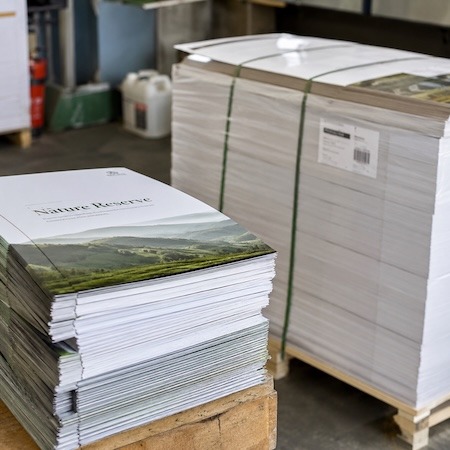

Today’s printing machines handle any order size – including a single copy. A service that used to be hard to get, like printing just one copy of a book, is now completely standard at druck.pl.
The price per piece still drops as the run size grows. That’s the effect of fixed costs, which come with every print job. Their size varies by technology, but they’re always there.
This question usually comes up when a client gets a quote and doesn’t understand why 100 pieces cost barely less than 500. The answer lies in the cost structure, not in some artificial threshold set by the printer.
Why a Minimum Print Run Practically Doesn’t Exist
Modern digital machines print a single copy just as smoothly as a hundred. They don’t need a physical form or lengthy setup – any file can be printed right away, regardless of order size.
That’s why our printer won’t turn down an order for one piece. The question isn’t “can this small a run be printed,” but “how much will one piece cost at this run size.”
The technical limits that used to force minimum runs – like the need for a costly printing plate – now apply only to select methods, mainly offset and certain finishing techniques.
Fixed Costs and the Unit Price of Printing
Print pricing has two parts: fixed costs and variable costs.
- Fixed costs – file preparation, machine setup, a form if needed – stay the same regardless of order size.
- Variable costs – paper, ink, machine time per piece – scale with the number of copies.
With a small run, fixed costs dominate. With a large run, they become almost negligible per piece.
How the Price Actually Changes Across Different Run Sizes
The relationship between run size and unit price isn’t linear – it’s a curve that drops sharply at first, then flattens out.
For a typical digital print job, like company brochures:
- 10 copies might cost barely less than 50 copies, since the same setup costs dominate either way.
- 50 to 200 copies is the range where the unit price drops most noticeably.
- Above 200–300 copies, the drop in unit price clearly slows down, since fixed costs are already well spread out.
That’s why ordering 250 pieces instead of 100 often ends up only slightly more expensive in total, despite being two and a half times the quantity.
The Highest Fixed Costs – Offset Printing
Offset printing carries the highest fixed costs of all the available technologies. That comes from the technical setup needed before printing even starts – printing plates have to be made, exposed, and the machine precisely calibrated for a given color and format.
In return, this technology delivers a very low unit price at larger volumes. Past a certain threshold, offset starts beating every other print method on price.
Offset also adds another fixed cost: color registration – aligning the machine so every color layer matches within a fraction of a millimeter. This takes longer than with digital printing, but at high volumes that time spreads across thousands of sheets.
The Lowest Fixed Costs – Digital Printing
Digital printing has the lowest fixed costs. The machine doesn’t need physical forms – it prints straight from a file, so production setup is quick and the cost of this stage is minimal.
That’s why digital printing works best for small and medium runs, and also wherever each copy needs to be different, as in personalized printing.
Large-format printing, used for things like banners and posters, carries similarly low fixed costs. That’s why a single advertising banner can be ordered without much of a small-run surcharge – unlike a single package requiring a custom die-cutting form.
Minimum Print Run and the Technology Break-Even Point
Rough thresholds where one technology starts beating another on price:
- Up to a few hundred pieces – digital printing usually works out cheaper.
- A few hundred to a few thousand pieces – depending on format and color count, the offer levels out.
- Above a few thousand pieces – offset starts clearly winning on unit price.
The exact threshold depends on the specific project – format, number of colors, and material type. That’s why a printer asks about the planned order size before quoting a price.
When It’s Worth Ordering a Single Copy or a Very Small Run
Ordering just a few pieces makes sense more often than it might seem. Typical situations where a small run is fully justified:
- A prototype or sample before approving a larger order.
- Materials for a single event, like a conference or trade fair.
- A limited edition or a gift for one specific person.
- Testing a new product before deciding on production scale.
In each of these cases, a higher unit price is a reasonable cost of flexibility – especially since the alternative is tying up budget in a run that might not pan out.
How to Order a Minimum Print Run Without Overpaying
A few design decisions genuinely lower the price of a small order:
- Choosing digital printing over offset when the run falls below offset’s break-even point.
- Skipping a custom shape in favor of a ready-made die-cutting form.
- Limiting the number of spot colors to the essential minimum.
- Combining several small orders into one machine run, if the timeline allows.
An order coordinator helps assess which technology and which simplifications will genuinely lower the price for a given run, instead of guessing based on general rules. For orders spanning several markets or company branches, the coordinator also makes sure small batches for different locations don’t each generate their own separate fixed costs.
Summary
There’s no technical minimum today that would prevent printing a single piece. A smaller order’s unit price is higher not because the printer sets an artificial threshold, but because fixed costs spread across fewer copies. Digital and large-format printing, with the lowest fixed costs, work best for small and medium runs. Offset, despite higher setup costs, wins on price at high volumes. Choosing a technology matched to the order size is the simplest way to avoid overpaying – whether the order is for one piece or several thousand.
FAQ
Is there a minimum print run?
Not in a technical sense – modern digital machines can print even a single copy. The unit price is lower for larger orders, though.
Why does a small quantity cost more per piece?
Because fixed costs – file prep, machine setup, a form if needed – spread across fewer copies and don’t shrink along with the order.
Which technology has the lowest fixed costs?
Digital and large-format printing, since they don’t require physical printing plates and print directly from a file.
At what quantity does offset become cheaper than digital printing? I
t depends on the project, but usually above a few thousand pieces offset clearly wins on unit price.
Is it worth ordering a single copy before a large run?
Yes, especially as a prototype or approval sample – the higher unit price is a small cost compared to the risk of an error across the whole run.