



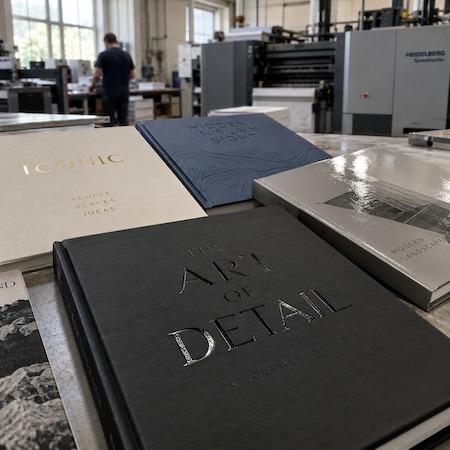

Cover finishes are additional processes applied after printing that change how a surface looks or feels – from glossy foil, through embossing, to a soft-touch laminate. Each effect changes how a cover comes across in someone’s hands, so it’s worth knowing the differences before picking one for a specific project.
This question comes up a lot with premium projects, where the client knows they want “something more” than plain printing, but doesn’t always know the names of the individual techniques.
Why Cover Finishes Change How a Product Comes Across
Graphics alone mostly appeal to the eye. A finish adds touch to that – a reader immediately feels the difference between a smooth, matte surface and raised embossing or a glossy accent. That first impression, even before opening a book or catalog, shapes a lot of how the whole product gets judged.
That’s why choosing a finish is worth treating as part of the design, not an afterthought tacked on at the end.
12 Cover Finishes in Practice
Here are twelve techniques most commonly used on the covers of catalogs, books, and premium packaging:
- Glossy foil – a thin layer of metallic foil applied under high pressure and heat. Gives a strong, mirror-like shine, most often on a logo or title.
- Matte foil – the same technique as glossy foil, stamped onto a specific spot, but without the shine. Adds elegance without looking flashy.
- Holographic foil – stamped similarly to glossy foil, but shifts color and shine depending on the viewing angle. Used mainly as an accent, rarely across a whole surface.
- Hot foil stamping – a die pressed under high heat gives the surface a permanent relief shape, often combined with foil.
- Cold foil stamping – foil applied without heating the die, allowing finer detail and smoother color transitions.
- Embossing – a section of the design rises above the cover’s surface, noticeable under the fingers.
- Debossing – the opposite of embossing, a section of the design is pressed into the material.
- Thermography – heat-cured powder gives selected print elements a raised texture, without needing a die like embossing does.
- Full UV coating – the entire cover surface coated in glossy, UV-cured varnish, resistant to scratches.
- Spot UV varnish – varnish applied only to a chosen spot, creating a gloss-and-matte contrast against the rest of the cover.
- Structural varnish – a variant of UV varnish with added 3D texture, noticeable under the fingers despite flat printing underneath.
- Soft-touch laminate – a film laminated over the entire cover surface, with a rubbery, slightly textured feel, pleasant to touch and resistant to fingerprints.
How to Choose Cover Finishes for Your Project
Not every finish suits every material and purpose. Embossing works best on thicker, stiffer board – thin paper won’t hold a pressed shape permanently. Soft-touch laminate works well on covers that clients pick up repeatedly, since it hides fingerprints better than a glossy surface.
Spot UV varnish and foil look best on a dark, matte background – that’s where the contrast shows up most clearly. On a light, glossy material, the effect can be barely noticeable, despite costing the same to produce.
How Much Cover Finishes Cost
Price depends on three factors: the size of the treated area, the number of separate finishes on one cover, and the print run size. Each additional technique is a separate production step, with its own machine and its own downtime between processes.
Combining several finishes at once – say, hot stamping with foil plus spot varnish – raises the cost more than proportionally, since each extra step needs precise alignment with the one before it. A single, well-chosen finish often makes a stronger impression than several at once, at a lower total cost.
Summary
Cover finishes offer twelve different ways to make a project stand out – from a subtle matte foil to bold embossing. The right choice depends on the base material, how the cover will be handled, and the budget. Instead of combining several techniques at once, a single, precisely chosen finish often works better – making an impression without driving up the cost unnecessarily.
FAQ
Which cover finish holds up best to frequent handling?
Soft-touch laminate – its slightly textured surface hides fingerprints more effectively than glossy finishes.
Does embossing work on any material?
No, it works best on thicker, stiffer board. Thin paper won’t hold a pressed shape permanently.
Does combining several finishes significantly raise the price?
Yes, the cost rises more than proportionally, since each additional technique is a separate production step requiring precise alignment.
Which finish best highlights a logo on a dark cover?
Glossy foil or spot UV varnish – both give the strongest contrast against a dark, matte background.