



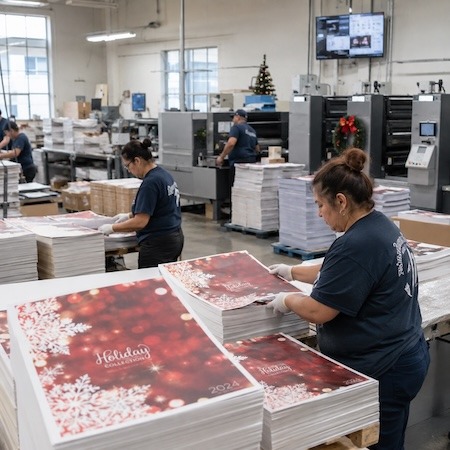

Seasonal printing should be ordered 6–8 weeks ahead of holidays and promotional campaigns, since lead times can double during peak season. High-demand materials – like decorative paper or shrink film – can run out weeks before the holidays themselves.
This question usually comes up too late. A client calls in November asking for Christmas printing and hears that schedules are already tight. Planning ahead saves both stress and money.
Why Seasonal Printing Follows Different Rules
Outside peak season, a printer has spare production capacity and can take on orders on short notice. During peak season – before holidays, Black Friday, or trade fair season – the same order waits longer in the queue, since many companies order at once.
That’s why lead times quoted outside peak season aren’t a reliable guide for seasonal orders. It’s worth asking directly about current turnaround times for that specific period, rather than assuming they’ll match a quieter month like March.
When to Order Seasonal Printing to Avoid Delays
Rough timeframes that hold up for typical holiday campaigns:
- Catalogs and promotional flyers – order 6–8 weeks before the campaign starts.
- Holiday packaging and personalized inserts – 8–10 weeks, due to the time needed for forms and personalization.
- Simple promotional materials, like posters or standard business cards – 3–4 weeks is enough even in peak season.
The more complex the project – finishing, custom shapes, personalization – the earlier the order should go in.
Seasonal Printing and Material Availability
Some materials have limited availability during peak season. Decorative paper with a metallic sheen or shrink film for gift wrapping can sell out weeks before the holidays, as many companies order them at the same time.
It’s worth asking the printer about a specific material’s availability at the planning stage, not just when placing the order. Switching materials at the last minute almost always extends the timeline.
How Seasonal Printing Gets Planned with an Order Coordinator
For seasonal orders, the coordinator assigned to the client sets a schedule for the whole project ahead of time – from file approval, through a print proof, to full production. That way the client knows the deadline for submitting final files in order to make the campaign date.
This matters especially for companies ordering print for several markets at once, where different language versions need to enter production in a coordinated sequence.
What Happens When an Order Hits Peak Season Without Advance Planning
An order placed without advance notice during peak season usually has two options. A longer wait in the standard queue, or express production for an extra fee, if the printer has spare capacity. Not every deadline can be sped up, though, especially with materials that are temporarily unavailable.
That’s why last-minute orders more often end in a compromise – for example, switching to a material available on hand instead of the one originally planned.
Seasonal Printing and Recurring Annual Campaigns
Companies ordering the same type of seasonal printing every year – holiday catalogs, calendars, packaging for a specific campaign – gain the most from planning ahead. A familiar die-cutting form, a proven material, and a ready design template can shave several days off preparation time compared to starting from scratch.
That’s one reason it’s worth keeping documentation from a previous seasonal order. It speeds up quoting and production the following year.
Summary
Seasonal printing needs different planning than off-season orders, since lead times stretch out and some materials become temporarily unavailable. A safe timeframe is 6–8 weeks ahead for standard promotional materials, and 8–10 weeks for projects involving personalization or custom shapes. Reaching out to an order coordinator early makes it possible to set a realistic schedule, instead of relying on turnaround times typical of quieter months.
FAQ
How much lead time is needed for standard seasonal printing?
Usually 6–8 weeks before the campaign starts, depending on the scale of the order.
Can express printing be ordered during peak season?
Sometimes, for an extra fee, if the printer has spare production capacity. This doesn’t apply to materials that are temporarily unavailable, though.
Why are some materials unavailable before the holidays?
Because many companies order them at the same time, and production or import can’t keep up with the seasonal spike in demand.
Is it worth keeping documentation from a previous seasonal order?
Yes, it speeds up quoting and production the following year, especially for recurring campaigns.