




In the world of printing, one decision can determine success or a costly mistake. That decision is often a sample print run. For some, it’s an unnecessary expense; for others, it’s a crucial step in quality control. The truth lies in the middle. Not every project needs a test run, but in some cases, a lack of a test run can mean serious financial and image consequences.
In this article, we show you when a proof run makes real sense, how it differs from a proof, and what it looks like from the technical side at a print shop.
What is a sample print run and how it differs from a proof
First, let’s sort out the terms. A proof is a single test print – usually digital, color-controlled, used to evaluate the colors and overall appearance of a design. However, it does not reflect all the characteristics of the final product. A proof will not show how the paper will behave when sewn, how the spine will look at a given volume, or whether a selective varnish will “sit” well on a particular surface.
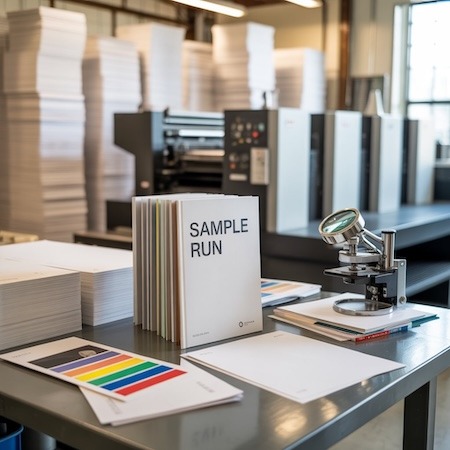
A sample print run is more than that. It is a small series of copies made with the same materials and processes as the actual production. This means a realistic representation of the final product – with binding, finishing, creasing, gluing or sewing.
In practice, a trial run makes it possible to assess:
- The actual thickness and rigidity of the finished product,
- the behavior of the paper when bent and bound,
- the visual effect of embossing, foil, varnish,
- comfort of use (e.g., opening the book, turning pages),
- overall premium or budget impression.
This is a completely different level of verification than the proof itself.
When a sample print run really makes sense
Not every project requires a test run. For simple brochures, standard catalogs or advertising materials based on proven solutions, a test run is often not necessary. If you use the same papers, the same binding and a similar design as before, there is little risk.
However, there are situations where a trial run is worth considering as part of a safety strategy:
- When the project includes unusual enhancements (e.g., 3D varnish, multi-level embossing),
- when you use non-standard paper (very thick, structured, tinted paper),
- when the volume of the book is limiting for the selected binding,
- when you are planning a large print run (several thousand copies),
- when the product is to go to retail and must meet high quality expectations.
In such cases, test printing minimizes the risk. The cost of several test copies is sometimes incomparably lower than the cost of correcting the entire production.
What a sample print run looks like in practice
The process of completing a proof run at a printing plant is not fundamentally different from standard production. The difference is in the scale. Instead of thousands of copies, we produce a few or a dozen pieces, keeping the same technology.
The files go to the prepress, undergo imposition, then we print the sheets, do the binding and all the prescribed finishing. As a result, the customer receives a physical product that he can test: view in natural light, check for durability, show to his team or business partners.
The turnaround time for a trial run is sometimes shorter than full production, but it should be factored into the project schedule. If you are planning a product launch for a specific date, the execution of the sample needs to be planned well in advance.
Does it pay off?
The most common question is: is it worth it? The answer depends on the context. If you are printing 100 copies of a simple notebook, the cost of a test run may be disproportionate to the total. However, if you are planning 10,000 copies of a catalog with an embossed cover, it may be risky to forgo a test run.
It’s worth looking at the bigger picture. A proof edition is not only a quality control, but also a decision-making tool. Often it is only in hand that you can see if the paper is too thin, the cover too soft or the varnish too subtle. With a test run, you can make adjustments before going into full production.
Summary
A sample print run is not a mandatory step in every project, but in many cases it is a reasonable precaution. It allows you to check the real effect, test materials and avoid costly surprises.
If you’re not sure whether a proof run is necessary for your project, it’s worth consulting with the printer. Sometimes a few extra test copies give much more peace of mind than a perfectly prepared PDF.