



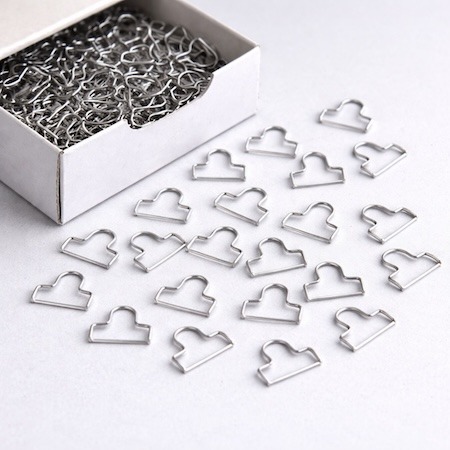

Inconspicuous but extremely practical, ring eye staples are a solution that can change the way you present your printed materials. Although at first glance they look like ordinary staples, their design allows for convenient storage of documents in binders. Find out when it is worth choosing this type of binding and what you need to know before making a printing decision.
What are ring eye staples – and how do they differ from classic staples?
Ring eye staples are a type of staple used in notebook binding, which instead of lying flat against the cover, form loops bent outward. This allows brochures and catalogs to be easily inserted into binders without the need to punch holes in the pages.
From the outside, they look almost identical to classic staples. Only from the inside can you see the difference in the bend. Their biggest advantage is their functionality, while maintaining the full aesthetics of the binding.
2. Who are ring eye staples best suited for?
This type of binding is recommended wherever the printed material will be used frequently, reviewed, compared with other documents or included in larger sets. Typical applications:
- operating instructions,
- catalogs of parts or products,
- training materials,
- reports and tender documents,
- bids with attachments.
Ring eye staples are particularly practical in technical and office environments. They facilitate archiving and everyday work with documentation.
3. What to look out for?
Although they do not require additional openings or other design changes, they involve several technical aspects that are worth planning in advance. First – the brochure must be designed with adequate internal margins so that when clipped into a binder, the content is not cut off.
Second – it is worth remembering that such staples are minimally more expensive than classic ones. The difference is not large, but for print runs of thousands of copies it can make a difference. Printers usually have a dedicated line for such binding, so it is worth confirming the availability of this option in advance.
4. Ring eye staples vs. hole punching – which to choose?
Some customers are faced with a choice: a classic punched brochure or perhaps just eyelet staples? Both solutions have their place, but the latter is definitely better for projects where aesthetics matter.
Mechanical punching can lead to accidental destruction of pages or disruption of layout. Eyelet staples do not interfere with the content, allow full margins to be maintained and eliminate the risk of errors when punching by hand. It’s convenience – for both the ordering party and the end user.
5. Do ring eye staples fit every format?
They are most often used for A4 and A5 brochures, but there is nothing stopping them from being used for more non-standard projects as well. Provided the document has an even number of pages and is suitable for notebook binding. The minimum volume is usually 8 pages, the maximum – about 60-64 pages (depending on paper weight).
It’s also worth mentioning that some printers also offer them in combination with varnishing, foiling or additional perforations. So if you’re planning an extended project, ask about possible combinations of technologies.
Summary
Ring eye staples are an underrated but very practical solution that combines the aesthetics of a brochure with the convenience of a binder. They do not affect the structure of the document, do not require additional manual operations, and at the same time look professional and neat. If you want your materials to last longer than just a moment, this is an option definitely worth considering.