



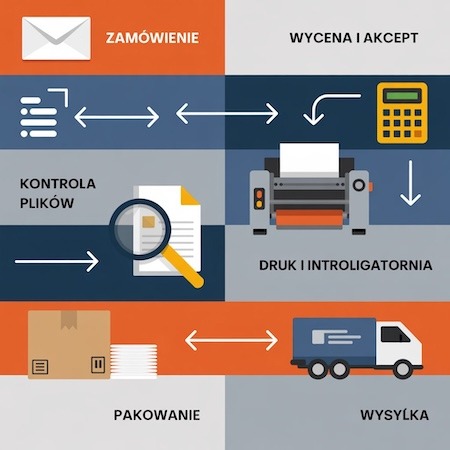

A well-planned printing house workflow – what a day looks like from order to shipment workflow is the key to quality, timeliness and efficiency. What happens at the print shop when you click “send inquiry”? Many people think that it’s enough to send the file and it’s done – the machine prints, the courier picks up, the customer is happy. But the reality is a much more complex process.
It all starts with a calculation and file check
The first step after receiving an inquiry is not the machine, but the calculator. The sales or calculation department analyzes the parameters of the project: format, paper, circulation, finishing, packaging, transportation. If something is unclear – the customer gets additional questions. Only when everything is confirmed, an offer is prepared.
Once it is accepted, the stage of file preparation begins. The customer sends a PDF, which goes to prepress control. At this stage, format compatibility, bleeds, colors, graphic resolution, margins and many other details are checked. If the file requires corrections, the graphic designer reports this to the client. When everything is in order – a proof or visualization is prepared (if needed).
What does a printing house daily workflow include?
Once the files are approved, the project goes into production. And this is where the real operational work begins. A typical day at the print shop is:
- Scheduling of machines according to occupancy and type of projects,
- preparation of printing forms (e.g., CTP plates in offsets),
- printing (digital, offset or hybrid),
- print quality control on an ongoing basis,
- drying of sheets (if necessary),
- bindery – cutting, folding, stapling, gluing, creasing,
- packaging of the project as agreed.
Some processes – such as foiling, hot-stamping, embossing, UV varnishing – take place in separate departments, depending on the scale of the print shop. The greater the automation, the smoother the print shop’s workflow, but still every piece passes through the hands of machine operators and quality controllers.
Printing house workflow is also logistics and packaging
Finally – before the product reaches the customer – comes the logistics. The project goes to the shipping department. There it is packed as agreed: individually, collectively, with or without labels, in corrugated cardboard boxes, wrapped in foil or kraft paper. If insertion (e.g., leaflets inside the book) or labeling with EAN code was envisaged – this is also done before shipping.
Couriers usually pick up finished packages at specific times. Large orders go on pallets, smaller ones as parcels. International shipments must be properly marked (including VAT-EU, customs documents, GLS/DHL/UPS labels).
Why is a well-thought-out printing house workflow essential for success?
A printer’s workflow is more than a set of procedures. It’s a system that ensures that the customer gets the finished product as ordered, in a timely manner, with quality and aesthetics. At a time when customer expectations are rising and deadlines are tightening, a well-planned process is not only a convenience, but a necessity.
Automated systems prompt operators on the order of work, remind them of color tests, and organize orders by type and run. But even the best system can’t replace experience and the human eye – that’s why a print shop’s workflow is not only technology, but also a close-knit team.
Summary
If you’ve ever wondered what happens to your project after a quote is approved – now you know. From calculation, prepress, printing and bindery, to packaging and shipping, every step of a print shop’s workflow matters. And a well-designed process is a guarantee that everything will go according to plan.