



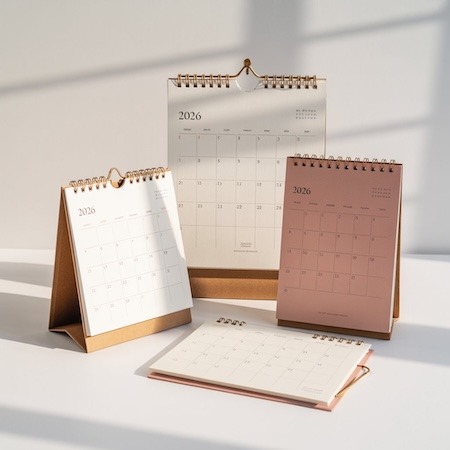

Printing calendars is an annual ritual for many companies. But 2026 brings new possibilities – from eco-friendly papers to sophisticated finishing and creative formats. If you’ve been ordering “the same thing you’ve always done” until now, it’s time to change that. We suggest how to refresh your corporate calendar for a “wow” effect without increasing your budget.
1. Printing calendars as an image tool
Until a few years ago, a calendar was mainly a vehicle for dates and logos. Today, it can be an extension of your corporate identity and branding. What can you add to gain value?
- tidbits about your brand next to selected days,
- quotes, company slogans or CSR slogans,
- subtle illustrations to match the graphic line,
- seasonal QR codes leading to current campaigns.
Such a calendar will not only be functional, but also memorable.
2. Paper – not just chalk
Printing calendars on 170g chalkboard is the standard. But is it the best? Depending on your purpose, you may want to consider other papers:
- Munken Polar – naturally white, uncoated, prestige,
- RecyStar Nature – 100% recycled, slightly creamy, FSC-certified,
- Keaykolour – dyed in the mass if you want to go wild with the base color,
- CircleOffset White – an eco-friendly alternative to matte chalk.
It is also worth remembering that paper affects not only the appearance, but also the weight of the shipment.
3. Format and design – or how to stand out
The A3 wall calendar is a classic, but in 2026 you should think more broadly:
- 4-month wall calendars with space for notes,
- A6 format pyramid calendars with original graphics (great for offices),
- notebook-calendars with perforations that the user can tear off and use as a reminder card.
- Folding slatted calendars, convenient for mailing.
Magnets, hanging holes, or an extended back with space for a company contact are also interesting additions.
4. Enhancements – a detail that gets the job done
Calendar printing can also be an opportunity to showcase quality – not only in content, but also in finishing. Increasingly popular are:
- Soft-touch film – pleasant to the touch, matte,
- UV selective varnish – for logo or graphic of the month,
- hot stamping – gold or silver,
- blind embossing – an elegant effect of “denting” the paper without color.
All these procedures ensure that your calendar does not land in a drawer – but stays with the recipient all year.
5. Printing calendars with personalization – the hit of low print runs
Digital printing today allows you to make short runs of personalized calendars. You can:
- add the name of the client or partner,
- put dedicated events on specific days,
- create a calendar for a specific team or branch.
Personalization increases engagement – and with print runs of 50-100 pieces, it’s a cost-effective solution.
Summary
Printing calendars doesn’t have to be a boring year-end chore. It can be a great marketing tool, an aesthetically pleasing image carrier and, most importantly, a useful gift that customers will actually use. In 2026, it’s worth thinking: what can I do differently? And let the calendar really work for your brand.