



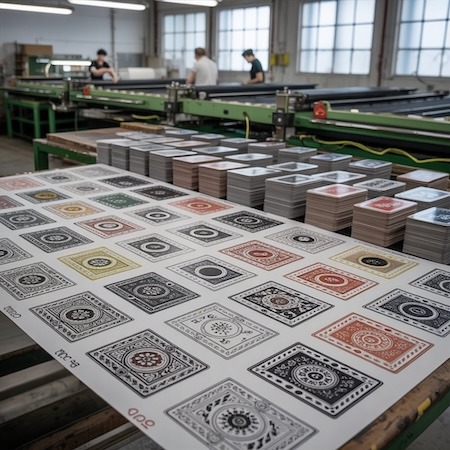

At first glance, playing cards printing seems simple: design, print, cut and done. In practice, however, producing sets with many different motifs – for example, 20 variants in one set – is one of the more challenging jobs in a printing house.
Why? Because in such a project it’s not just about the quality of printing, but above all about the logistics of production, sorting and checking the completeness of the sets. It is these elements that determine whether the final product will be correct.
Below we show step-by-step how playing card printing looks like in such a case.
Playing card printing starts with files
When it comes to playing cards, file preparation is key. Each theme must be correctly described and organized. If a set contains 20 different cards, each must be clearly labeled – both in file names and in the project structure.
Why is this so important? Because at the production stage all the motifs are combined into one printing process. Without clear labeling, it is very easy to get confused when assembling the sets.
Even at this stage, the printing of playing cards requires great precision.
Playing card printing vs. imposition
The next step is the preparation of the imposition, that is, the arrangement of the cards on the printing sheet. This is one of the most important moments of the entire process.
The printer has to decide:
- how many cards will fit on one sheet
- how to arrange different motifs
- how to optimize paper consumption
With many motifs, mixed sheets, that is, sheets with different versions of cards, are often used. This allows multiple variants to be printed simultaneously and optimizes production.
Poorly planned imposition can significantly increase the cost or make subsequent sorting difficult.
Printing of playing cards and selection of materials
Playing cards are most often printed on coated paper with a higher grammage, such as 300-350 g, often with an additional stiffening layer (the so-called core). Depending on the project, different materials are used:
- classic GC1/GC2 cartons
- black core paper
- blue core paper
Each of these materials affects the rigidity, durability and use of the cards.
Card printing also very often includes enhancements such as matte, gloss or soft touch foil, which improve surface resistance and user comfort.
Playing card printing vs. cutting and rounding
After printing, the sheets go for further processing. First, the sheets are cut to card format and then the corners are rounded.
This is a step that seems simple, but is of great importance. Even slight misalignments can make the cards look unsightly or make them uneven in the deck.
Therefore, printing playing cards requires very precise die-cutting and quality control at this stage.
Printing playing cards and sorting sets
The biggest challenge with many motifs is not the printing itself, but putting the kits together.
If one set is to contain 20 different cards, then each pack must be assembled from exactly those 20 items – with no gaps and no repeats.
Depending on the circulation, the following is used:
- manual picking
- semi-automatic sorting systems
- packaging lines with set control
This is where mistakes are most likely to occur if the process is not well planned.
Card printing vs. packaging
The last stage is packaging. Depending on the project, the kits can be:
- banded
- packed in plastic bags
- put into boxes
With many motifs, it is important to maintain full control over what goes into a single package. Therefore, additional labeling or control systems are often used.
The most common mistakes when producing multiple themes
Finally, it is worth noting the most common problems:
- Lack of clear labeling of motifs in files
- ill-considered imposition
- underestimation of time for sorting
- lack of control of completeness of sets
It is these elements that determine whether card printing will run smoothly.
Summary
Printing playing cards with multiple motifs is a process that requires not only good printing quality, but more importantly, production organization. Files, imposition and the way sets are completed are crucial.
The more variants in a single project, the greater the importance of logistics. And it is this that most often determines the success of the entire production.