



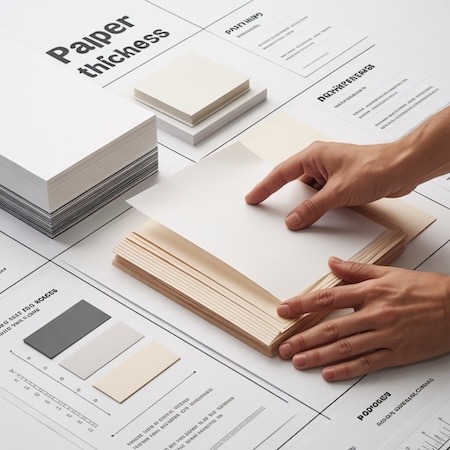

Paper thickness is one of the most common topics discussed with print shop customers – whether printing books, flyers or packaging. While the topic may seem technical, it has a huge impact on the quality, feel in hand and functionality of the finished product. In this article, we’ve collected the 5 most common questions asked by customers who don’t work with print on a daily basis, but want to get the paper thickness right for their project.
Paper thickness vs. grammage – are they the same thing?
This question almost always arises. In everyday language, “paper thickness” is often equated with grammage, but in practice they are not the same thing. Grammage refers to the weight of the paper expressed in grams per square meter (gsm), while thickness is the actual physical dimension. Most often measured in micrometers or millimeters.
For example, two 250 gsm papers may have different thicknesses if their composition differs (e.g. coated vs. uncoated paper). That’s why 170 g chalk paper seems thinner than 160 g offset paper – its texture is more compact. Therefore, for projects where the feel in the hand matters (business cards, invitations, packaging), it is worth looking not only at the grammage, but also the physical thickness and stiffness of the material.
What should I choose for the catalog?
The thickness of the paper in catalogs should be chosen to combine comfortable browsing with appropriate prestige. The most commonly used papers are 130-170 g for the inside pages and 250-350 g for the cover. But this is only part of the puzzle – the actual thickness is equally important.
It is worth remembering:
- The more pages, the thinner the paper of the center should be. To avoid an overly thick and bulky publication.
- A thicker cover always adds to the impression of solidity – especially with matte or soft touch foil.
- For premium projects, consider lining the cover with bookbinding cardboard.
Are there paper thickness standards for books?
There is no single standard, but the thickness of paper in books depends strongly on the intended use. Fiction books usually use 80-100 g offset (thickness of about 90 to 120 μm), while children’s books or books with illustrations often use 120-140 g offset or 130-170 g chalk paper.
In educational books and workbooks, the texture of the paper is also important – can you write on it? Does it not puncture? Good printers have samples and can show how the thickness varies at the same grammage, depending on the type of material.
What mistakes do customers make when choosing paper thickness?
This question does not fall directly, but the answer can be inferred from many conversations. The most common mistakes are:
- Choosing a paper that is too thin – a 90 g leaflet can appear cheap and not very durable.
- Choosing paper too thick – for example, for a 48-page booklet with notebook binding, where the thickness causes the center to not close.
- Failure to consider thickness when selecting envelopes – 300 g sheets may not fit into standard C5 envelopes.
How do I check the thickness of the paper before printing?
The best – in person. If possible, ask for samples from the printing house. Good printers have their catalog of papers with descriptions of grammage, thickness and stiffness. You can also ask for a sample to be sent to you before accepting production, especially for high print runs or important advertising material.
Thickness information is not included in the PDF files for printing. It’s a decision you need to make before you start production. If you’re inexperienced, trust the printer – but also ask how the thickness will translate into shipping weight, packaging cost, or method of display (e.g., on a POS stand).
Summary:
Paper thickness is not only a matter of aesthetics, but also functionality. It affects the impression, durability, shipping costs and comfort of use. That’s why it’s worth taking a moment to choose the right material – and if in doubt, always ask the printer. It is better to prevent than to regret that the product looks different from what we expected.