




To understand why the pages of a book must be a multiple of four, you need to look into the printing process itself. If you’ve ever prepared a book for printing, it’s very possible that the printer pointed out one thing to you. The number of pages must be divisible by four. To many people this sounds like a technical detail, but in practice it is one of the basic rules of book production.
Interestingly, this is not due to any “whim” of the printer, but to how the book is physically produced.
Book pages vs. printing sheets
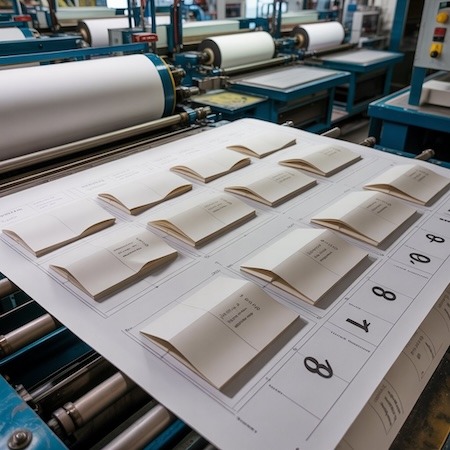
Books are not printed page by page, as they appear in a PDF file. In fact, printing is done on large sheets of paper with many pages at once.
Several, a dozen, and sometimes even dozens of pages are placed on a single printing sheet – in a special layout. This layout is called imposition and is designed so that when the sheet is folded, the pages are in the correct order.
After printing, the sheet is folded (folded) and then trimmed. And this is where the key principle comes in: one folded sheet always yields a certain number of pages, most often a multiple of four.
Why do the pages of the book come out in “fours”
Imagine the simplest case: one sheet of paper printed on both sides and folded in half.
- on one side you have 2 sides
- on the other side you have another 2 pages
When folded, this gives a total of 4 pages of the book.
This is the absolute basis. Each successive folding of the sheet increases the number of pages, but always in the scheme resulting from this logic. That’s why standard folds have, for example, 8, 16 or 32 pages – that is, they are always multiples of four.
In practice, this means that the entire book must consist of such “blocks”. It is impossible to put in 2 or 3 pages “loose”, because they do not physically fit into the production process.
Book pages vs. contributions
In print production, the term “typesetting” is used. This is the kind of printed and folded sheet that makes up a section of a book.
A typical book is made up of many folds, which are later joined together:
- by sewing
- by gluing (e.g. PUR)
Each typesetting has a certain number of pages – usually 16 or 32. This means that the total number of pages of the book must match these blocks.
If the project has, for example, 150 pages. Then in practice you need to “beat” it to the nearest number compatible with the technology – that is, 152 or 160 pages, for example.
What happens when the number of pages does not agree
If the number of pages is not a multiple of four, the printer must do something about it. Most often one of two solutions is used:
- addition of blank pages
- slightly changing the volume of the project
Blank pages often appear at the end of a book and are perfectly normal. In many publications they are even standard and do not negatively affect the reception.
Moreover, sometimes designers intentionally leave such pages – for example, for notes or as a compositional element.
Book pages vs. cost optimization
The fact that the pages of a book are multiples of four also affects the cost of production. Properly matching the volume to the premiums makes it possible:
- reduce paper waste
- make better use of the printing sheet
- reduce unit cost
That’s why printers often suggest slightly changing the number of pages – for example, adding 2-4 pages – to make production more efficient.
Why you should keep this in mind at the design stage
From the client’s point of view, the most important thing is to take this principle into account at the beginning of work on the book. This way it can be avoided:
- amendments at the final stage
- delays in production
- unnecessary costs
In practice, a simple rule of thumb will suffice. When planning a book, it’s a good idea to immediately think of the number of pages as a multiple of four.
Summary
The fact that the pages of a book are multiples of four is a direct result of printing technology and the way the sheets of paper are folded. Each sheet forms a certain number of pages, and the entire book is a collection of such folds.
Therefore, even if two pages are “missing” from the design, the printer still has to include them – usually in the form of blank pages.
It’s a small detail, but it shows how closely the book’s design is tied to the production process. And it is things like this that most often determine whether printing will go smoothly or whether unnecessary complications will arise.