



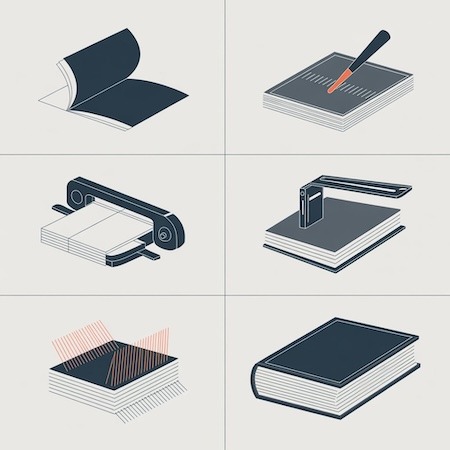

Many people, when thinking about the production of printed materials, focus only on the graphic design and the printing itself. Meanwhile, an equally important stage begins only after the sheets come off the printing press. This is when the bookbinding processes enter, i.e. all the activities that give the print its final form.
It is through them that loose sheets of paper are turned into a catalog, brochure, book or packaging. Bookbinding processes range from simple operations, such as trimming or folding paper, to more advanced steps involved in binding a publication.
Below you will find an expanded glossary of the most important terms that often come up when communicating with a print shop.
Bookbinding processes involved in sheet preparation
The first group of processes concerns the preparation of printed sheets for further production. This is the stage that organizes the material and gives it the right shape.
- Cutting – This is one of the basic bookbinding processes. After printing, sheets of paper usually have a larger format than the final product. Special bookbinding guillotines cut them to the final size with great precision. Accuracy is important at this stage – even small deviations can affect the aesthetics of the entire publication.
- Folding – Folding involves folding sheets of paper in a specific way. Depending on the project, the sheet may be folded in half, accordion or in several directions. This process is used in folded flyers, brochures or manuals. With folding, a large printing area can be organized in a convenient form.
- Creasing – Creasing is the making of a controlled indentation in the paper at the point of future folding. It is used primarily with thick papers and cardboard. Without creasing, the material could crack at the bend or damage the print. The process makes the bend even and aesthetically pleasing.
- Perforation – Perforation involves making a line of tiny cuts in the paper. Thanks to them, a piece of material can be easily torn off. Perforation is encountered in tickets, coupons, vouchers or forms.
- Die cutting – This process allows custom shapes to be cut out of paper or cardboard using a die-cutter. Thanks to die cutting, for example, packaging, hang tags or unusual advertising materials are created. For packaging, this is one of the key production processes.
These bookbinding processes are primarily responsible for giving the material the right shape and preparing it for the next stage of production.
Bookbinding processes involved in page binding
The second group includes processes that combine multiple pages into a single publication. This is where brochures, catalogs or books are created.
- Booklet binding – In this method, paper folds are stapled together with metal staples along the spine. This is one of the most popular methods of binding brochures and magazines. Staple binding allows the publication to open almost flat, making it easier to read.
- Glue binding – In glue binding, individual pages or folds are joined by glue in the spine. This type of binding is often used for catalogs, reports and books with larger volumes. It allows for an elegant, straight spine with printability.
- Sewn and glued binding – This is a more permanent solution than glued binding alone. The folds are first sewn together with thread and then additionally glued in the spine. This makes the book more resistant to heavy use and opens better.
- Hardcover binding – One of the most prestigious binding methods. The book block is mounted in a rigid cover made of paper-covered cardboard or cloth. This binding often uses additional elements, such as capitals or ribbons.
- Capital – This is a small decorative strip of material placed at the top and bottom of the spine of the book. Although it serves mainly an aesthetic function, it also reinforces the structure of the spine.
All of these bookbinding processes affect the durability of the publication, the way it is opened and the overall perception of the product.
Why bookbinding processes are so important
Although printing is the most visible stage of production, it is the bookbinding processes that determine the functionality and quality of the finished product. They determine whether a catalog will browse well, whether a book will be durable, and whether a package will fold correctly.
Well-chosen finishing processes can also significantly affect the aesthetics of a project. Precise folding, even creasing or sturdy binding make the material look professional and comfortable to use.
Summary
Bookbinding processes are an integral part of the production of printed materials. They are what turn sheets of paper into finished products – from simple flyers to complex book publications and packaging.
Knowledge of these concepts facilitates communication with the printing house and helps to better plan the project already at the stage of preparing materials for printing.